August 2026 was a loaded month for hearing aid technology. Four major manufacturers (ReSound, Oticon, Phonak, and Signia) all released new flagship hearing aids within a few weeks of each other, and every one of them relies on some version of AI-driven sound processing. If you've been holding off on an upgrade, this is the most interesting stretch of new releases we've seen in years.
We carry all four of these brands here at North Shore Hearing, and patients have already been asking which one is right for them. Here's a quick rundown of what's new in each.
ReSound Sensia
ReSound's new Sensia builds on the Vivia platform that came before it, and ReSound calls it the world's smallest AI hearing aid. In its top technology level, Sensia introduces a feature called Intelligent All-Around. It pairs a real-time sound classifier called AcoustIQ with four-microphone directional technology and a new AI denoising system. Instead of just amplifying whatever is loudest in the room, it's built to lift the voice you're trying to follow, and it does that when you simply face the person you're talking to.
ReSound reports that AcoustIQ classifies listening environments with 88 percent greater accuracy than the closest premium competitor. That matters because a feature only helps if it switches on at the right moment. Battery life comes in at 24 hours in the rechargeable microRIE and rechargeable custom styles, even with AI noise reduction switching on automatically. Sensia also comes in bimodal versions built to work alongside Cochlear sound processors.
Oticon Reveal
Oticon took a different route with Reveal. Rather than one AI system trying to do everything, Reveal splits the work between two networks running at the same time. Speech AI sharpens the voices you want to hear, and Context AI protects the background sounds that keep a room feeling real. Oticon calls the target result a "balance point," and that phrase sums up the whole philosophy. Nobody wants dead silence except for one voice. People want clarity without losing the room around them.
Reveal also brings a reworked feedback-prevention system, the Reveal Optimizer. Its new connectivity platform improves streaming range and stability over the previous generation, according to Oticon. Reveal uses Oticon's existing premium chargers, and the new CROS transmitter for single-sided hearing loss charges on the same ones. The real change is in the processing underneath.
Phonak EON
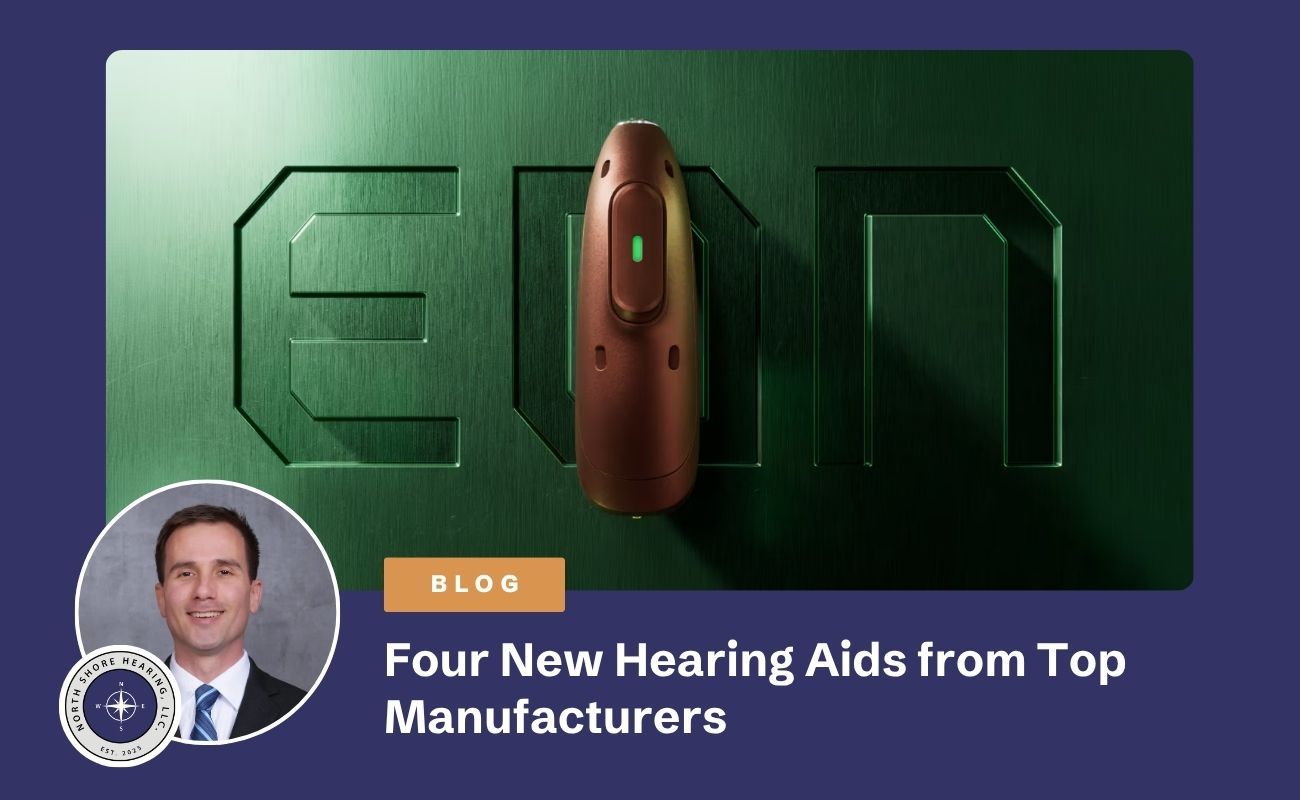
Phonak EON is the third generation of the company's Sphere technology, and the headline change is size. It's 25 percent smaller and 20 percent lighter than the previous Sphere platform. It's built around a new Hypersonic processing chip and an updated version of Spheric Speech Clarity for pulling speech out of noise.
Notably, Phonak made this level of speech-in-noise processing available across three performance tiers this time, not just the top two. EON also adds WindBlock 2.0 for outdoor wind noise and native Auracast support. Battery life holds up under heavy streaming, at around 22 hours with demanding daily use.
Signia MaX
Signia's approach might be the most ambitious of the four. MaX runs four separate deep neural networks at once:
- one for detecting speech
- one for recognizing your own voice
- one for reading the surrounding environment
- one for judging noise
All four share information in real time, a step past older systems that treat noise reduction as its own isolated task.
Signia is marketing MaX under the phrase "Live Noisy," built on the idea that background sound isn't always something to erase. A restaurant, a family gathering, a busy street corner: these places carry noise worth keeping, and MaX is built to sort out what to soften and what to leave alone. It offers broad Bluetooth connectivity, a built-in telecoil, and Auracast-capable hardware. Full Auracast function is expected through a firmware update in the Signia One app by March 2027.
Which One Is Right for You
Four strong releases in one month sounds great until you're the one trying to pick between them. Two people with nearly identical hearing tests can do better with completely different technology, depending on lifestyle, ear anatomy, and which everyday situations give them the most trouble.
Dr. Aussem fits every patient personally and uses Real Ear Measurement to verify your fit rather than relying on manufacturer claims alone. He can walk you through how these four compare and let you hear the difference, here in Glendale or through mobile care at your home or senior living community. If one of these new releases caught your attention, call us at (414) 906-1145 and we'll help you find the one that fits your life.